
Living in the Dominican Republic: lifestyle, things to do & facts
Comprehensive daily living guide for international residents: private gated communities with tier-one security, the golf capital of the Caribbean, cosmopolitan dining, remote-work connectivity, and sociocultural integration keys in .
Lifestyle in the Dominican Republic: climate, comfort, and international living standards
Relocating your life goes beyond tax and wealth planning; it is the deliberate choice of a new personal and family environment. Beyond its robust territorial tax system and investor incentives, the Dominican Republic offers an everyday standard of living that combines first-world comforts with the relaxed pace of the Caribbean in .
A tropical climate with more than 300 days of sunshine per year, master-planned private communities built around strict security protocols, cosmopolitan dining, and daily direct flights of two to four hours to North American hubs make the country a premier destination for corporate founders, remote executives, and retirees under the Law 171-07 annuitant and pensioner regime.
Neighborhood security and private gated communities
Safety is often a primary consideration for families evaluating a relocation to the Caribbean. In daily practice, the lifestyle of international residents and investors centers around master-planned gated communities and prime urban districts operating under integrated private security protocols:
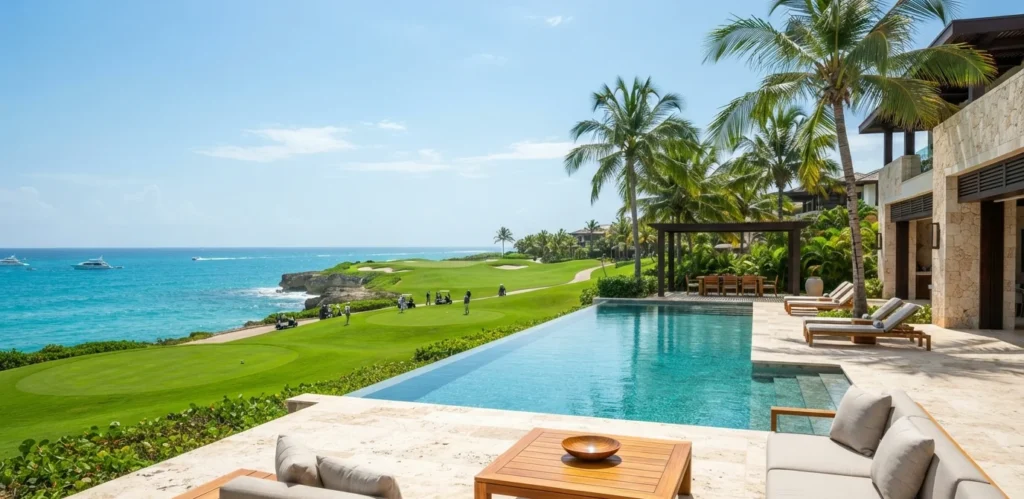
Gated communities such as Cap Cana, Puntacana Resort & Club, and Casa de Campo feature dedicated private security forces, biometric perimeter checkpoints, 24/7 patrols, and virtually non-existent crime rates.
In Santo Domingo, prime sectors like Piantini, Naco, Bella Vista, and Anacaona feature luxury residential towers with controlled access lobbies, automatic backup power generators (full plants), and continuous private security.
Destinations like Las Terrenas (Samaná) or Sosúa and Cabarete (North Coast) blend walkable oceanfront living with secure residential compounds, ideal for those seeking nature and outdoor pursuits.
Many of these residential master plans also allow buyers to acquire properties under the statutory tax incentives of the CONFOTUR Law, eliminating the 3% property transfer tax and the 1% annual property tax (IPI).
Sports and leisure infrastructure: the golf and yachting capital of the Caribbean
The Dominican Republic is widely recognized as the premier golf destination in Latin America and the Caribbean, repeatedly awarded by the International Association of Golf Tour Operators (IAGTO). Legendary course architects such as Pete Dye, Jack Nicklaus, Tom Fazio, and Gary Player have sculpted world-renowned oceanfront courses along cliffs and white-sand beaches.
| Sports & leisure facility | Geographic location | Course architect / Class | Distinguishing highlights |
|---|---|---|---|
| Punta Espada Golf Club | Cap Cana | Jack Nicklaus Signature | Ranked #1 course in Mexico and the Caribbean by Golfweek; 8 holes playing directly along the sea. |
| Teeth of the Dog | Casa de Campo (La Romana) | Pete Dye | Top 50 global ranking; 7 holes carved into coral rocks on the Caribbean Sea (flanked by Dye Fore and The Links). |
| Corales Golf Club | Puntacana Resort & Club | Tom Fazio | Official home of the PGA Tour in the Dominican Republic; finishes at the dramatic cliffside Devil’s Elbow. |
| Marina Cap Cana | Cap Cana | State-of-the-art marina | Over 150 slips accommodating mega-yachts up to 250 feet; global epicenter for championship billfish sportfishing. |
| Cabarete Watersports Hub | Puerto Plata (North Coast) | World wind sports capital | Global benchmark for kitesurfing, windsurfing, wing foiling, and ocean surfing at Playa Encuentro. |
The sporting landscape is rounded out by premier equestrian and polo clubs (at Casa de Campo and Los Establos in Cap Cana), high-performance tennis academies, and internationally certified reef-diving centers.
Fine dining, private social clubs, and nightlife
The Dominican culinary scene has matured into a sophisticated, cosmopolitan landscape. The capital, Santo Domingo—twice crowned the Capital of Gastronomic Culture in the Caribbean by the Ibero-American Academy of Gastronomy—hosts Michelin-caliber dining and forward-thinking establishments blending local ingredients with contemporary international culinary technique.
High-level networking spaces favored by top executives and diplomatic families, such as the Santo Domingo Country Club, the Santo Domingo Yacht Club, and exclusive business lounges across the central financial district.
From open-air courtyard dining in the historic Colonial City to waterfront boardwalk bistros in Cap Cana and Casa de Campo, offering authentic Mediterranean, Japanese, French, and modern Caribbean fusion.
The Dominican Republic is the world’s leading exporter of premium hand-rolled cigars. Private tasting rooms and cigar clubs form an organic part of the country’s executive social fabric.
To understand the expenses associated with maintaining an executive lifestyle, review our detailed guide on the cost of living in the Dominican Republic.
Domestic household staffing, concierge services, and family living quality
One of the most notable lifestyle advantages appreciated by entrepreneurs and families moving to the Dominican Republic is the widespread availability and affordability of professional domestic household assistance in .
Unlike North America or Western Europe, where full-time domestic support is cost-prohibitive for most households, hiring dedicated staff is common and regulated under the Labor Code (Law No. 16-92):
Full-time live-in or daily staff managing housekeeping, laundry, and daily residence operations. Typical monthly salaries range between $350 and $600 USD per month.
Trained cooks experienced in international dietary requirements, fresh market provisioning, and meal preparation for private family entertaining.
Vetted, experienced childcare providers capable of assisting with school schedules, extracurricular activities, and language development.
Technical management for residential pools, tropical gardens, vehicle fleets, and private properties within gated residential communities.
Domestic employment legislation includes healthcare coverage through the Social Security Treasury (TSS) and mandatory statutory 13th-month Christmas pay (regalía), ensuring a stable and protected contractual relationship. For a broader comparison of monthly living costs, review our analysis on the cost of living in the Dominican Republic.
Expat communities and regional settlement hubs by lifestyle profile
International expat distribution across the country aligns with distinct professional, retirement, and recreational priorities:
Relocating families also have access to accredited international schools offering the International Baccalaureate (IB) in English and French, as well as a network of private hospitals and modern clinics across these key regions.
Sociocultural facts and practical tips for seamless integration
Understanding everyday cultural dynamics ensures a smooth, rewarding transition to Dominican life:
- Interpersonal warmth and hospitality: Dominicans are celebrated for their spontaneous welcoming nature and willingness to assist newcomers. Genuine personal courtesy and relationship-building precede all successful business conversations.
- Perceptions of time: In informal social settings, time is viewed flexibly (evident in local colloquial expressions like “ahorita”, which can mean now, later, or sometime today). Conversely, within corporate banking, legal firms, and top-tier commercial circles in Santo Domingo, strict international punctuality applies.
- Unique gemstones found nowhere else: The Dominican Republic is the only place on Earth where Larimar (a rare turquoise-blue volcanic pectolite) is mined, and is home to rare, fossil-rich Blue Amber prized by gemologists globally.
- Baseball as a national passion: Baseball (known locally as pelota) is far more than a pastime—it is a cultural institution. The country is the leading international exporter of players to Major League Baseball (MLB) in the United States, and attending professional winter league games between October and January offers an unforgettable cultural experience.
- “The Caribbean Alps” (Jarabacoa and Constanza): Many newcomers are surprised to discover that the island is home to the highest mountain peak in the entire West Indies (Pico Duarte, 10,128 feet / 3,087 meters) and temperate alpine valleys where strawberries are cultivated and winter nighttime temperatures drop below 50°F (10°C), just two hours from coastal beaches.
Interactive selector: ideal residential destination evaluator
Identify the region of the Dominican Republic that best aligns with your leisure preferences, family needs, and desired lifestyle pace in :
Digital connectivity, telecommunications, and work-life balance
For entrepreneurs and professionals operating international businesses under the foreign-source territorial tax exemption, the country’s technological infrastructure readily supports high-bandwidth remote operations:
Telecommunications infrastructure and strategic time zone
- High-speed fiber optics: Major carriers (Claro and Altice) provide symmetrical fiber plans up to 1,000 Mbps across Santo Domingo, Santiago, Punta Cana, Cap Cana, and Las Terrenas.
- Starlink satellite availability: Fully operational nationwide, delivering low-latency satellite broadband even in rural mountain retreats or aboard maritime vessels.
- Strategic time zone (GMT-4): Aligned with US Eastern Standard Time (Miami and New York) during Daylight Saving Time, allowing full working day overlap with North America and morning synchronization with Europe.
- Coworking spaces and tech hubs: Modern shared workspaces in Santo Domingo and along the north coast hosting recurring technology, investment, and digital asset networking events.
If you plan to relocate your equipment, vehicles, and personal belongings, review statutory customs duty exemptions in our guide on how to import a vehicle and the steps to transfer a driver’s license in the Dominican Republic.
Microclimates, tropical seasons, and luxury infrastructure resilience
Understanding local seasonal patterns allows you to plan your daily life with complete peace of mind. Beyond the simplified notion of uniform tropical weather, Dominican geography features a diverse mosaic of microclimates shaped by three interior mountain ranges:
Semi-arid coastal microclimate with steady Atlantic sea breezes. Features the lowest coastal rainfall in the country, guaranteeing sunny days nearly year-round with pleasant temperatures of 78°F to 85°F (26°C to 29°C).
Humid tropical microclimate marked by brief, refreshing showers that nourish lush coconut forests and emerald hills cascading straight to the ocean shore.
Temperate mountain climate with average temperatures of 60°F to 72°F (16°C to 22°C), lit fireplaces in winter, and rivers and pine forests situated 4,000 feet above sea level.
Structural resilience and energy independence in premier communities
A common question among international buyers is weather resilience during the Atlantic hurricane season (June to November). In master-planned gated communities and developments certified under the CONFOTUR Law, engineering and infrastructure follow strict civil standards:
- Seismic-resistant reinforced concrete construction paired with hurricane-impact glass windows and doors.
- 100% underground electrical utility grids backed by industrial automatic backup power generators (full plants) with long-range diesel storage.
- Private water filtration, deep well infrastructure, and desalination facilities in master developments like Cap Cana and Puntacana Resort.
Frequently asked questions about daily life in the Dominican Republic
What is daily security like for foreign residents in the Dominican Republic?
The vast majority of international residents and investors live in high-end gated communities such as Cap Cana, Puntacana Resort, Casa de Campo, or executive residential towers in Santo Domingo (Piantini and Naco). These enclaves feature restricted biometric access, 24/7 private security patrols, and exceptionally low crime rates.
What is the year-round climate like for permanent living?
The Dominican Republic enjoys a warm tropical climate twelve months a year, with average temperatures ranging between 77°F and 86°F (25°C to 30°C) and more than 300 guaranteed days of sunshine. The central mountain regions (such as Jarabacoa and Constanza) offer a temperate, spring-like climate with lows of 54°F to 60°F (12°C to 16°C).
What premier leisure and sports amenities exist in the country?
The country is recognized as the golf capital of the Caribbean, boasting more than 25 championship golf courses (designed by Jack Nicklaus, Pete Dye, and Tom Fazio) that host official PGA Tour events. In addition, it offers full-service mega-yacht marinas in Cap Cana and La Romana, world-class equestrian and polo centers, and fine dining.
Is it feasible to work remotely and operate global digital businesses from the Dominican Republic?
Yes. Major cities and coastal resort areas offer high-speed symmetrical fiber-optic internet (Claro and Altice) up to 1,000 Mbps, alongside nationwide Starlink satellite coverage. Its time zone (Atlantic Standard Time / GMT-4) is ideally aligned with both the US East Coast and European business hours.