
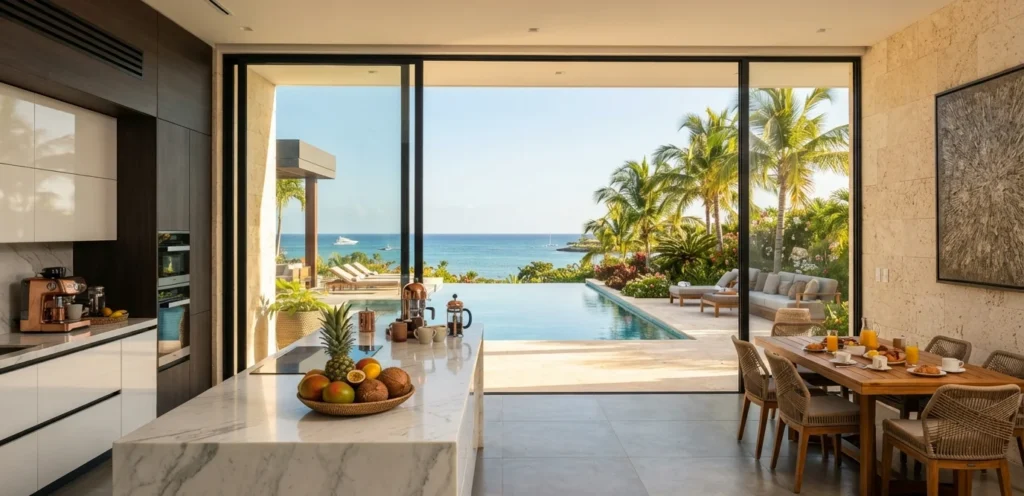
Cost of living in the Dominican Republic: housing, utilities & expenses
Comprehensive economic and budgetary analysis for international residents: real rental and purchase prices in prime neighborhoods, electric and internet utilities, international schools, domestic staffing, and profile comparisons in .
Cost of living in the Dominican Republic: housing analysis, utilities, and monthly budget
For investors, independent professionals, and families evaluating a transfer of tax residency to the Dominican Republic, accurately modeling actual operational expenses is essential. Combining a tax framework governed by the territoriality principle with a cost of living significantly lower than in North American or Western European capitals yields an immediate increase in net purchasing power in .
According to monetary data from the Central Bank of the Dominican Republic (BCRD) and regulatory guidelines from the Superintendence of Banks (SB), the country benefits from a stable dual-currency economy. In premier residential enclaves (such as Cap Cana, Punta Cana, Las Terrenas, or the financial center of Santo Domingo), high-value contracts are settled seamlessly in US dollars (USD), while everyday retail purchases are transacted in Dominican pesos (DOP).
Residential market: rental and purchase prices in exclusive zones
Housing represents the largest single item in an expat’s monthly budget. In the Dominican Republic, rental and acquisition costs vary substantially between private beachfront resort communities and the metropolitan financial district:
| Geographic zone and property type | Average monthly rent (USD) | Approximate purchase price per sq. meter | Neighborhood profile |
|---|---|---|---|
| Punta Cana & Bávaro (2-bedroom condo in gated community) | $1,200 to $2,200 USD | $1,800 to $2,600 USD/m² | Resort communities with shared pools, 24/7 security, and beach club access. |
| Cap Cana (Luxury marina condo or golf villa) | $2,500 to $6,000+ USD | $2,800 to $4,500 USD/m² | Ultra-luxury enclave, PGA golf courses, mega-yacht marina, and maximum privacy. |
| Las Terrenas (Samaná) (Oceanfront villa or penthouse) | $1,500 to $3,500 USD | $2,000 to $3,000 USD/m² | Boutique European community, contemporary architecture, and lush tropical surroundings. |
| Santo Domingo (Piantini / Naco) (Modern executive high-rise) | $1,400 to $3,000 USD | $2,200 to $3,200 USD/m² | Central financial district, full backup power generators, and diplomatic proximity. |
If you are considering purchasing property rather than leasing, units certified under the CONFOTUR Law grant a 100% exemption from the 3% property transfer tax and a 0% annual Real Estate Property Tax (IPI) for 15 years, dramatically reducing ongoing carrying costs.
Basic utilities and maintenance: electricity, internet, and HOA fees
Residential utility expenses feature specific dynamics that should be planned accurately:
Power rates range from $0.22 to $0.34 USD per kWh (through private utilities like CEPM in the East or state distributors like EDE). A condo with moderate A/C usage averages $120 to $250 USD/month, whereas large villas with continuous climate control run $400 to $700 USD/month. Rooftop solar photovoltaic installations typically amortize within three years.
Symmetrical high-speed fiber internet (300 to 500 Mbps with Claro or Altice) costs $45 to $75 USD per month. Starlink residential satellite service is available nationwide at roughly $55 USD/month. Unlimited 5G mobile data plans with international calling cost $25 to $40 USD monthly.
In private residential buildings, monthly HOA fees range from $150 to $450 USD for apartments, and from $300 to $800 USD in luxury master-planned resorts. Fees cover 24/7 security checkpoints, diesel fuel for full automatic backup generators, swimming pool maintenance, landscaping, and trash collection.
Banking costs, transfer fees, and currency management (USD/DOP)
Managing cross-border funds and foreign cash flow is a central operational priority for any relocating expatriate. Regulated by the Superintendence of Banks (SB) and protected by ProUsuario, the Dominican financial network provides transparent multi-currency operations tailored to international transfers in :
Commercial banks (Banco Popular, BHD, Banreservas) charge a flat fee of $15 to $35 USD per incoming international wire, crediting funds directly into your US dollar account without forced conversion into pesos.
Maintaining savings or checking accounts in USD and DOP is typically free or carries nominal fees ($3 to $8 USD monthly) if a standard minimum average balance is maintained.
The currency exchange margin between the US dollar and the Dominican peso monitored by the Central Bank of the Dominican Republic is competitive, averaging between 0.8% and 1.2% across commercial branches and online banking.
Foreign Visa and Mastercard credit cards are accepted universally. Domestic ATM cash withdrawals incur standard local network dispensing fees of RD$ 250 to RD$ 400 DOP (~$4 to $7 USD) per transaction.
To optimize your financial setup and avoid international transaction surcharges, opening local accounts upon receiving your legal residency Cédula or forming a limited liability company (SRL) to manage your assets is highly recommended.
Food and grocery budget: local produce vs. imported goods
Food expenses vary depending on shopping preferences. Locally produced foods (tropical fruits, fresh seafood, local beef, poultry, vegetables, and regional coffee) are exceptionally affordable and of outstanding quality. Conversely, gourmet imports from the US or Europe incur customs tariffs and the 18% VAT (ITBIS) administered by the DGII.
| Grocery staple or dining service | High-end supermarket price range (USD) | Approximate Dominican peso equivalent (DOP) |
|---|---|---|
| Premium beef tenderloin (1 kg / 2.2 lbs) | $12.00 to $18.00 USD | RD$ 720 – 1,100 DOP |
| Fresh chicken breast (1 kg / 2.2 lbs) | $5.00 to $7.50 USD | RD$ 300 – 450 DOP |
| Catch of the day fresh fish (Grouper/Snapper, 1 kg) | $9.00 to $14.00 USD | RD$ 540 – 850 DOP |
| Whole pasteurized milk (1 liter) | $1.40 to $1.80 USD | RD$ 85 – 110 DOP |
| Farm-fresh eggs (Dozen) | $2.00 to $2.80 USD | RD$ 120 – 170 DOP |
| Quality imported wine bottle (Mid-to-high tier) | $14.00 to $25.00 USD | RD$ 850 – 1,500 DOP |
| Executive multi-course dinner at a fine dining restaurant | $40.00 to $85.00 USD | RD$ 2,400 – 5,100 DOP |
Modern supermarket chains such as Supermercados Nacional, Bravo, and La Sirena carry an extensive selection of international brands, organic foods, and imported goods across all primary expat living hubs.
Mobility and transportation: fuel, vehicle purchases, and importation
A private vehicle is the preferred mode of transportation for international residents. Mid-to-full-size SUVs (4WD/AWD) are optimal for navigating coastal roads, highways, and metropolitan traffic comfortably:
Review detailed vehicle shipping steps in our guides on how to import a vehicle to the Dominican Republic and transferring your driver’s license.
Healthcare budget and international school tuition
Access to accredited international education and private medical care are primary considerations for relocating families:
Comprehensive domestic private insurance (Mapfre BHD, Humano) costs between $70 and $160 USD monthly per person. International global health policies (Bupa, Cigna) including medical evacuation to Florida range from $200 to $400 USD monthly.
View healthcare and hospital network analysis →Annual tuition at accredited international bilingual academies (in Santo Domingo, Punta Cana, or La Romana) ranges from $5,000 to $14,000 USD per student, noticeably below private school rates in the US or UK.
View international schools and IB programs →Domestic household staffing: housekeepers, drivers, and private chefs
Affordable domestic household staffing is a major quality-of-life advantage for international families living in the Dominican Republic. Staffing contracts are regulated under the Labor Code (Law 16-92):
- Full-time live-in housekeeper: From $350 to $550 USD monthly (RD$ 21,000 – 33,000 DOP) with room, board, and social security coverage (TSS).
- Full-time private cook or chef: Between $600 and $1,000 USD monthly depending on formal culinary training and experience in high-end private residences.
- Pool maintenance and landscaping: Regular scheduled maintenance runs between $150 and $300 USD per month.
To learn more about daily community life and social routines, read our complete guide on living in the Dominican Republic.
Comparative sample monthly budgets by resident profile
To provide realistic projections, here are three representative monthly budgets for comfortable upper-middle and luxury lifestyles in :
| Monthly expense category | Solo digital nomad / Professional (USD) | Retiree / Annuitant couple (USD) | Family of 4 (2 children) (USD) |
|---|---|---|---|
| Housing (Rental in prime neighborhood) | $1,200 USD (1-2 bed condo) | $2,000 USD (Luxury condo / villa) | $3,200 USD (3-4 bed villa) |
| Utilities (Electricity, internet, water, gas) | $180 USD | $280 USD | $450 USD |
| Groceries and household provisioning | $400 USD | $750 USD | $1,200 USD |
| Private health insurance | $100 USD (Platinum plan) | $350 USD (Comprehensive plan) | $550 USD (Family plan) |
| Transportation (Fuel and auto insurance) | $150 USD | $250 USD (1 vehicle) | $450 USD (2 vehicles) |
| Domestic household help | $80 USD (Part-time) | $450 USD (1 full-time housekeeper) | $850 USD (Housekeeper + cook) |
| International private school tuition | $0 USD | $0 USD | $1,500 USD (2 students prorated) |
| Leisure, dining, and social clubs | $450 USD | $700 USD (Golf, dinners) | $900 USD |
| ESTIMATED TOTAL MONTHLY BUDGET | $2,560 USD / month ≈ 2,355 € EUR |
$4,780 USD / month ≈ 4,397 € EUR |
$9,100 USD / month ≈ 8,372 € EUR |
Maintaining an equivalent lifestyle in cities like Miami, New York, Zurich, or London would require doubling or tripling these expenditure levels—with the added benefit that foreign-source income remains tax-exempt under Law 171-07.
Interactive budget configurator: personalized monthly calculator
Customize each expense category according to your household preferences and desired lifestyle to estimate your monthly budget in the Dominican Republic in :
Tax arbitrage and the purchasing power multiplier effect
The primary financial benefit of moving your residency to the Dominican Republic is not merely that day-to-day expenses are 35% to 50% lower than in major Western capitals, but the impact of net tax arbitrage: combining affordable living with an effective 0% tax rate on foreign-source income.
The following table illustrates the annual net wealth preservation for an independent professional, investor, or executive earning $150,000 USD gross annually from international sources:
| Annual financial metric | Residing in high-tax jurisdiction (US / Canada / Western Europe) | Residing in the Dominican Republic (Dominicana Way) |
|---|---|---|
| Gross annual income | $150,000 USD | $150,000 USD |
| Direct income taxes (State/Federal/Cantonal) | -$60,000 USD (~40% average effective rate) | $0 USD (0% territorial rate under Art. 269 / Law 171-07) |
| Net disposable income after tax | $90,000 USD net | $150,000 USD full net income |
| Annual living expenses (Luxury residence, dining, services) | -$68,000 USD (Upper-middle lifestyle) | -$54,000 USD (High-comfort standard of living with full-time staff) |
| ANNUAL NET CAPITAL SAVED | +$22,000 USD / year | +$96,000 USD / year |
The wealth preservation multiplier
Over a five-year period, a resident in the Dominican Republic under this framework accumulates $480,000 USD in net investable capital, compared to just $110,000 USD retained in a high-tax economy—while enjoying a significantly higher quality of daily life in the Caribbean.
To evaluate the legal steps required to formalize your tax departure and access this structure, review our guide on taxes and statutory benefits in the Dominican Republic.
Frequently asked questions about the cost of living in the Dominican Republic
How much money does an individual or couple need monthly to live comfortably in the Dominican Republic?
An independent professional or digital nomad can maintain a comfortable lifestyle with a monthly budget between $2,000 and $3,200 USD. A retired couple or annuitant under Law 171-07 can enjoy a high-end standard of living in gated communities with $2,800 to $4,800 USD per month, including quality housing, private health insurance, dining, and domestic help.
Why is the electric utility bill typically higher than in other countries?
Electric rates in the Dominican Republic generally range between $0.22 and $0.34 USD per kWh. Given the warm tropical climate, continuous air conditioning use can raise monthly bills to $150–$400 USD. Consequently, most modern luxury villas and contemporary developments integrate rooftop solar PV systems to reduce net power costs to negligible amounts.
Can you pay and conduct business in US dollars on a daily basis?
Yes. The Dominican Republic operates under a functional dual-currency framework in expat and resort regions. Real estate transactions, vehicles, international health insurance, high-end leases, and private international schools are quoted and settled directly in US dollars (USD), while the Dominican peso (DOP) is used for everyday groceries and local domestic services.
How much does it cost to hire domestic household staff or maintenance help?
Full-time domestic staff (live-in or daily) generally costs between $350 and $550 USD monthly, plus basic statutory social security (TSS) and mandatory Christmas bonus pay. A full-time private chef or driver typically earns between $600 and $1,000 USD per month.