
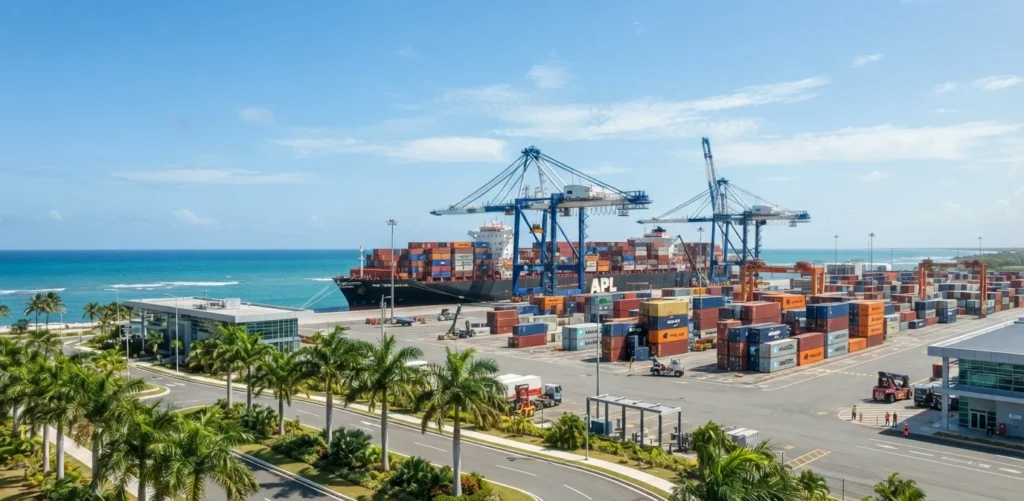
Moving to the Dominican Republic: relocation, customs & shipping
Comprehensive logistics guide for international residents and investors: maritime shipping options (FCL and LCL), 100% duty-free exemption under Law 171-07, port customs protocols, and secure door-to-door relocation in .
International relocation logistics: from your home country to your new Caribbean residence
Transporting your furniture, fine art, personal belongings, and vehicles marks the practical fulfillment of an international relocation. For international clients moving their assets to the Dominican Republic, importing household goods is regulated by the General Directorate of Customs (DGA) in close coordination with the Ministry of Finance and the Internal Revenue Service (DGII) in .
Unlike the standard customs regime—which assesses duties of up to 20% plus 18% VAT (ITBIS) on consumer goods—the Dominican legal system provides a robust statutory exemption framework through Law No. 168 on Relocation Customs Franchises and, specifically, Law No. 171-07 on Incentives for Retirees and Foreign Annuitants, compiled by the Legal Advisory Office of the Executive Branch. This statute grants a complete 100% exemption from all customs tariffs and import taxes on your entire household goods shipment.
Customs framework for household goods: standard regime vs. Law 171-07
The customs tax assessment on an international moving container depends directly on your legal residency status:
| Customs assessment category | Standard general import regime | Preferential regime under Law 171-07 | Financial impact |
|---|---|---|---|
| Customs import tariff (Gravamen) | Up to 20% on the customs appraised value | 100% full statutory exemption (0%) | Zero customs tariff payable on personal effects. |
| Value Added Tax (ITBIS) | 18% assessed on CIF value plus tariff | 100% full statutory exemption (0%) | Complete elimination of import VAT liability. |
| Average savings on a 40-foot container | Taxes ranging from $12,000 to $22,000 USD | $0 USD in customs duties | Direct cash tax savings exceeding $15,000 USD. |
| Statutory shipment arrival window | No special statutory time frame | Up to six (6) months after residency approval | Allows structured, phased home relocation. |
To access complete customs exemptions, applicants file their dossier under Law 171-07 for retirees and annuitants, certifying recurring monthly passive income ($2,000 USD/month) or a lifetime pension ($1,500 USD/month).
Maritime shipping modalities: full container (FCL) vs. consolidated groupage (LCL)
Choosing your ocean transport modality determines cargo security, port inspection timelines, and overall shipping costs:
The preferred option for complete family household moves. You secure an exclusive sealed ocean container of 20 feet (for a 1–2 bedroom apartment) or 40 feet / 40 High Cube (for larger residences with extensive furnishings).
- Exclusive security seals remain intact from origin residence to destination door.
- Direct port customs clearance with minimal physical cargo handling.
- Allows shipping a personal vehicle inside the container (if compliant).
Recommended for partial shipments, select personal items, home office equipment, or smaller volume moves that do not justify an entire container.
- Priced per cubic meter (m³) of actual volume occupied.
- Requires palletizing with heat-treated wooden crates (ISPM-15 standard).
- Slightly longer port deconsolidation and customs inspection times.
If you are planning to ship your personal vehicle alongside your household goods, review age restrictions and duties in our guide on how to import a vehicle to the Dominican Republic.
Interactive volume calculator: shipping container simulator and logistics costs
Estimate required cargo volume, container sizing, ocean transit times, and door-to-door relocation costs to the Dominican Republic in :
Door-to-door marine cargo insurance and tropical risk protection
A costly mistake when arranging international ocean freight is relying solely on the carrier’s baseline statutory liability. Under the Hague-Visby Rules, a maritime carrier’s legal liability is capped at nominal amounts (typically around $500 USD per lost or damaged package)—an amount clearly insufficient to protect fine art, designer furniture, or valuable electronics in .
To ensure complete asset protection, securing an All-Risk marine cargo insurance policy (Institute Cargo Clauses A) with door-to-door coverage is essential. It must incorporate three specific protective clauses:
Critical protection for maritime emergencies where the vessel master jettisons cargo to save the ship. Without this clause, cargo owners are legally liable to contribute proportionally to vessel rescue costs.
Tropical voyages subject steel containers to severe thermal swings that cause internal condensation (“container sweat”). The policy must explicitly cover mold, mildew, moisture, and oxidation to protect hardwoods and upholstery.
Coverage must extend through uncrating inside your new Dominican residence, allowing a 7-to-14-day window to report concealed damages not visible upon initial delivery.
The average premium for a comprehensive All-Risk policy ranges between 1.5% and 2.5% of the declared inventory value. This formal valuation also serves as legal documentation for filing your duty exemption dossier with the DGA under Law 171-07.
Mandatory documentation for household goods port customs clearance
To authorize inspection and customs release at port container terminals, your licensed customs broker must submit the following verified documentation to the DGA:
Issued by the international ocean carrier. Must name the residency holder or primary applicant as the ultimate consignee of the cargo.
Itemized box-by-box inventory of shipped items, stating estimated USD values and certifying used personal and domestic condition.
For Law 171-07 beneficiaries, this formal decree issued by the Ministry of Finance instructs customs to apply a 0% tariff and 0% VAT rate.
Original passport with the stamped residence visa from MIREX or the Foreigner Cédula issued by the Central Electoral Board.
Prohibited items, restricted goods, and agricultural biosecurity rules
To prevent cargo seizures or customs penalties, you must review goods that are strictly restricted or prohibited by law:
- Firearms and ammunition: Strictly prohibited in household moving containers. Importation requires prior authorization from the Ministry of Interior and Police and the Ministry of Defense.
- Fresh food and agricultural produce: Fresh fruits, seeds, live plants, raw meats, or unpasteurized dairy products are prohibited under Ministry of Agriculture biosecurity controls.
- Wine collections and spirits: Shipping private wine collections is permitted in reasonable personal quantities, but commercial volumes incur specific excise taxes (ISC).
- Pharmaceuticals in commercial quantities: Personal maintenance medications require a doctor’s prescription and must not exceed quantities indicative of commercial distribution.
For details on local medication availability and pharmacy services, read our overview of the Dominican healthcare system.
Pet relocation: veterinary health requirements and entry protocols
Importing domestic pets (dogs and cats) into the Dominican Republic is overseen by the General Directorate of Livestock (DIGEGA). The country enforces a straightforward entry protocol that does not require quarantine isolation if health requirements are verified:
Issued by a licensed veterinarian in the origin country within 15 days prior to departure, certifying the animal is free of infectious or contagious diseases.
Rabies vaccine administered between 30 days and 12 months prior to travel (except puppies under three months of age).
Internal and external deworming administered within 15 days prior to arrival. An official veterinary port entry fee of approximately $10 USD is paid upon entry.
Seaports, maritime transit times, and final overland transport
The Dominican Republic’s modern maritime port network provides premier container handling in the Caribbean basin:
Primary container terminals for household moves
Caucedo Multimodal Port (in Boca Chica) is the primary terminal utilized by premier ocean carriers (Maersk, Hapag-Lloyd, MSC, CMA CGM). Equipped with optical container scanners, it averages customs clearance in 3 to 6 business days following vessel discharge.
From Caucedo, container chassis transport cargo over multi-lane highways directly to gated communities in Punta Cana, Cap Cana, Casa de Campo, or residential towers in Santo Domingo.
Ocean sailing times are short from the US East Coast (3 to 5 days from Florida), averaging between 14 and 21 days from Western European ports. If planning exploratory travel ahead of your move, consult our guide on flights and airports in the Dominican Republic and our overview of legal residency and visa procedures.
Temporary bonded storage, demurrage prevention, and delivery in gated communities
During international moves, shipping containers frequently arrive at port before destination residences are fully ready (due to interior work or pending deed closings at the Real Estate Registry).
Coordinating this transition window with precision prevents unnecessary demurrage costs:
Preventing port demurrage and detention charges
Ocean carriers typically allow 7 to 10 free days for container clearance. After that grace period, container demurrage penalties range between $100 and $250 USD per day.
- Transfer to bonded logistics warehouse: If the residence is not ready, we arrange cargo devanning into secure, climate-controlled bonded storage at DP World Caucedo or Haina logistics parks, returning the ocean container and ending daily penalties.
- Truck weight restrictions in gated communities: In residential enclaves like Cap Cana, Puntacana Resort, or Casa de Campo, HOA bylaws prohibit heavy 40-foot articulated trucks to protect paved roads and golf course pathways.
- Shuttle truck transfer service: Cargo is cross-docked onto authorized smaller box trucks approved by community security to deliver directly to your villa doorstep.
This logistical coordination avoids community access friction and ensures delivery proceeds as smoothly as your legal and tax residency filing. To review household operational expenses, explore our guide on the cost of living in the Dominican Republic.
Frequently asked questions about moving to the Dominican Republic
Can you import furniture and personal household belongings duty-free into the Dominican Republic?
Yes. Pursuant to Law No. 171-07 on Special Incentives for Retirees and Foreign Annuitants, foreign nationals establishing legal residency under this regime enjoy a 100% exemption from customs tariffs and VAT (18% ITBIS) on all personal household furnishings and used personal effects, provided the shipment arrives within six months of receiving residency.
What is the difference between a dedicated container (FCL) and shared ocean groupage (LCL)?
A Full Container Load (FCL), typically 20 or 40 feet, is exclusively reserved for a single household, ensuring customs security seals remain unbroken from origin to final destination. Less than Container Load (LCL) consolidates multiple client shipments into a shared container, making it cost-effective for smaller loads but subject to longer port clearance times.
What are the requirements for bringing dogs or cats into the Dominican Republic?
You must present an official veterinary health certificate issued within 15 days prior to travel, proof of valid rabies vaccination, and documentation of internal and external deworming. Upon arrival, the pet undergoes inspection at the General Directorate of Livestock (DIGEGA) quarantine desk without requiring extended quarantine if records are compliant.
Which seaport is best suited for receiving an international household shipment?
Caucedo Multimodal Port (near Santo Domingo and Boca Chica) is the most modern, technologically advanced container terminal in the country. It offers direct highway links to Santo Domingo (25 minutes) and the resort communities of Punta Cana and Cap Cana (1 hour and 45 minutes).