
Education system in the Dominican Republic: international schools & universities
Comprehensive academic guide for international families: elite private schools with the International Baccalaureate (IB), US curriculum, transcript validation through MINERD, and placements at world-class universities in .
Structure of the Dominican education system: the private and international standard
For entrepreneurs, executives, and international families considering a move to the Dominican Republic, educational continuity for their children is an essential consideration. Beyond the benefits of its territorial tax system and investor incentives, the country is home to an established network of elite private international schools meeting high American and European standards in .
The national regulatory framework is established under General Education Law No. 66-97 through the Ministry of Education (MINERD) for primary and secondary education, and by the Ministry of Higher Education, Science, and Technology (MESCYT) for universities. In practice, international families enroll their children in bilingual and multilingual private institutions accredited by bodies such as the International Baccalaureate Organization (IBO), Cognia, or the New England Association of Schools and Colleges (NEASC), facilitating direct entry into top universities globally.
Premier international schools: Santo Domingo, Punta Cana, and major hubs
International education is strategically concentrated within the country’s primary residential and corporate communities:
| Educational institution | Geographic location | Curriculum & accreditation | Primary language of instruction | Estimated annual tuition (USD) |
|---|---|---|---|---|
| Carol Morgan School (CMS) | Santo Domingo (Central District) | US High School Diploma (AdvancED / NEASC), Advanced Placement (AP) courses | English (100% Immersion) | $11,000 to $16,500 USD |
| Saint George School | Santo Domingo (Piantini) | International Baccalaureate (IB – PYP, MYP, and Diploma Programme) & Cambridge | English & Spanish | $7,500 to $12,000 USD |
| Puntacana International School (PCIS) | Puntacana Village | NEASC accredited, International Baccalaureate (IB Diploma), official MINERD recognition | English (Bilingual) | $6,000 to $10,500 USD |
| Cap Cana Heritage School | Cap Cana | US curriculum, Cognia / SACS accreditation, Honors and AP courses | English (Immersion) | $6,500 to $11,500 USD |
| Abraham Lincoln School | Casa de Campo (La Romana) | British curriculum (Cambridge IGCSE) and Dominican official diploma | English & Spanish | $5,000 to $8,500 USD |
| Lycée Français de Saint-Domingue | Santo Domingo | Official French Ministry of National Education curriculum (AEFE network) | French (Bilingual/Trilingual) | $5,500 to $8,500 USD |
| International School of Sosúa (ISS) | North Coast (Puerto Plata / Cabarete) | Cognia accreditation, US High School Diploma for elementary and secondary | English | $5,500 to $9,000 USD |
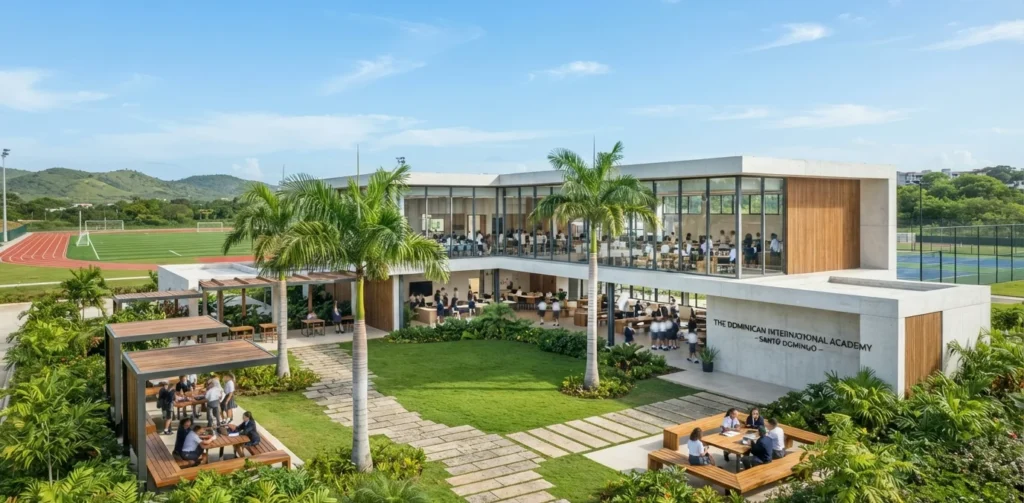
These campuses feature performing arts auditoriums, scientific and technology labs, regulation soccer fields, tennis courts, and semi-Olympic pools, serving a diverse student body representing over 40 nationalities.
Interactive search tool: international school recommender and tuition calculator
Select your target residential region and curriculum preferences to discover recommended academies and estimate your annual tuition budget in :
Curriculum frameworks and global accreditations: IB, US diploma, and European baccalaureate
Academic pathways are anchored in internationally recognized frameworks, allowing students to transfer credits smoothly to institutions worldwide:
Taught at institutions like Saint George School and Puntacana International School under the International Baccalaureate Organization. The rigorous IB Diploma Programme prepares students for competitive admissions across the Ivy League, the UK’s Russell Group, and European universities.
Offered by Carol Morgan School and Cap Cana Heritage School. Grants an accredited American diploma certified by regional agencies (NEASC or Cognia), with Advanced Placement (AP) courses granting college credit at US and Canadian universities.
The Lycée Français de Saint-Domingue and École Française Théodore Chassériau operate under France’s AEFE network, granting the official French Baccalauréat, while Abraham Lincoln School in La Romana follows the British Cambridge IGCSE curriculum.
Each of these curriculums can concurrently grant the official Dominican High School Diploma (*Bachiller*) through MINERD, awarding graduates a recognized dual qualification valid both domestically and internationally.
College counseling and placements at elite institutions in the US and Europe
A primary priority for international parents is ensuring that their children maintain direct access to competitive universities worldwide in .
Top-tier international academies (including Carol Morgan School, Saint George School, and Puntacana International School) maintain dedicated in-house college counseling departments integrated into the high school curriculum beginning in the 9th grade:
Campuses serve as official testing centers for the College Board, administering SAT exams and AP tests locally without requiring travel abroad to complete standardized assessments.
Graduates from these institutions regularly matriculate at top-tier universities such as Harvard, Columbia, Georgetown, Cornell, University of Pennsylvania, MIT, Stanford, and McGill University in Canada.
The IB Diploma and French Baccalauréat facilitate direct admission into the UK’s Russell Group (Oxford, Cambridge, LSE, King’s College) and European business universities such as IE University in Spain and Sciences Po in France.
International admissions officers value Caribbean-based applicants: students combine the academic rigor of an American or IB curriculum with multicultural, bilingual fluency, providing a unique profile compared to applicants from domestic school districts.
Tuition costs, admissions procedures, and international school calendar
Tuition and fees at private international schools follow a three-part structure:
- Application fee: A non-refundable fee of $100 to $350 USD covering academic evaluations and family admissions interviews.
- Capital enrollment fee: A one-time capital contribution paid upon initial entry to the school, ranging from $1,500 to $6,000 USD per student (with sibling discounts available at select institutions).
- Annual tuition: Billed in monthly installments (over 10 or 12 months) or with discounts for upfront annual payment. Tuition at premier academies ranges between $6,000 and $14,000 USD annually, significantly lower than comparable private day schools in Florida, California, the UK, or Switzerland.
School calendar and admissions windows
International schools operate on the Northern Hemisphere academic calendar (late August through mid-June). The formal application period opens between January and April for the subsequent school year. However, most schools in Punta Cana and Santo Domingo maintain rolling year-round admissions for families relocating mid-year or under legal residency programs.
To review how school tuition fits within an overall family budget, explore our comprehensive breakdown on the cost of living in the Dominican Republic.
Transcript validation and academic credit transfer procedures with MINERD
To officially validate foreign academic records within the Dominican education system, files are submitted to the Accreditation and Certification Department at MINERD:
The validation procedure takes between 15 and 30 business days. International schools permit conditional enrollment while the official equivalency resolution is finalized. Documents originating from non-Hague Convention nations require prior authentication through the Dominican consulate via MIREX consular services.
Language adaptation for international students and immersion programs
For families relocating from North America or Europe, language barriers in the classroom are eliminated from day one.
In premier international academies, English is the exclusive language of instruction for mathematics, sciences, literature, and technology, while Spanish is taught as an integrated curriculum course. Schools also provide structured support programs to facilitate student integration:
Linguistic and pedagogical support frameworks
- EAL programs (English as an Additional Language): For students arriving from non-English speaking nations (such as France, Germany, or Italy), specialized faculty provide targeted language support without separating students from their grade-level peers.
- Spanish as a Second Language (ELE): Students arriving without prior Spanish background receive progressive immersion instruction designed to build conversational and academic fluency within six to twelve months.
- Multicultural community support: With international and diplomatic families comprising over 40% of the student body, counselors are experienced in supporting children through cross-border relocations.
This immersion approach supports steady academic progress while equipping children of legal residents with natural fluency in two of the world’s most widely spoken business languages.
Universidades and graduate business schools in the Dominican Republic
At the tertiary level supervised by MESCYT, the country offers accredited universities maintaining dual-degree agreements with US and European institutions:
Ranked among the top universities in the country. Renowned for corporate law, civil engineering, and medicine, offering exchange programs with North American and European universities.
The leading graduate business school in the Caribbean, affiliated with IESE Business School (Spain). Delivers executive MBA, corporate governance, and senior leadership programs for multinational executives.
Universidad Iberoamericana (UNIBE) hosts an international community of US and Canadian students across its medical and dental faculties, while INTEC specializes in engineering and computer science.
Language immersion, equestrian sports, golf, and extracurricular growth
The Caribbean environment provides a balanced lifestyle combining academic standards with year-round outdoor sports and development:
- Natural multilingual development: Most academies teach in English and Spanish, with complementary programs in French, German, or Mandarin, helping expatriate children develop trilingual fluency from an early age.
- Championship sports facilities: Junior golf academies at PGA Tour courses (Punta Espada and Corales), tennis centers, competitive equestrian riding and show jumping (at Los Establos in Cap Cana), and sailing clubs.
- Environmental service learning: IB curriculum programs integrate Creativity, Activity, Service (CAS) projects focused on marine conservation, coral reef restoration, and tropical reforestation.
To review neighborhood safety and residential communities near these school campuses, read our analysis on lifestyle and security in the Dominican Republic, or explore private medical coverage in our private healthcare guide.
Frequently asked questions about the Dominican education system
What international accreditations do top private schools in the Dominican Republic hold?
The country’s leading international schools hold prestigious global accreditations including the International Baccalaureate (IBO), US regional accreditation from NEASC (New England Association of Schools and Colleges) and Cognia/AdvancED, and official approval from the French Ministry of Education (AEFE) for European curricula.
What is the average tuition cost at an elite international school?
Annual tuition at top international schools generally ranges between $5,000 and $16,000 USD per student depending on grade level and institution (such as Carol Morgan School, Saint George School, or Puntacana International School). Most institutions also assess a one-time capital admission fee upon initial enrollment.
What documentation is required to validate previous foreign school transcripts?
Validating foreign academic records with the Ministry of Education (MINERD) requires an apostilled birth certificate (Hague Convention), certified official transcripts from the most recent academic years apostilled in the issuing country, and a certified Spanish translation legalized by the Attorney General’s Office (PGR) if originally in another language.
What school calendar do international academies follow in the country?
The vast majority of private international schools follow the Northern Hemisphere academic calendar (US and European standard), starting classes in late August or early September and concluding the academic year in mid-June.